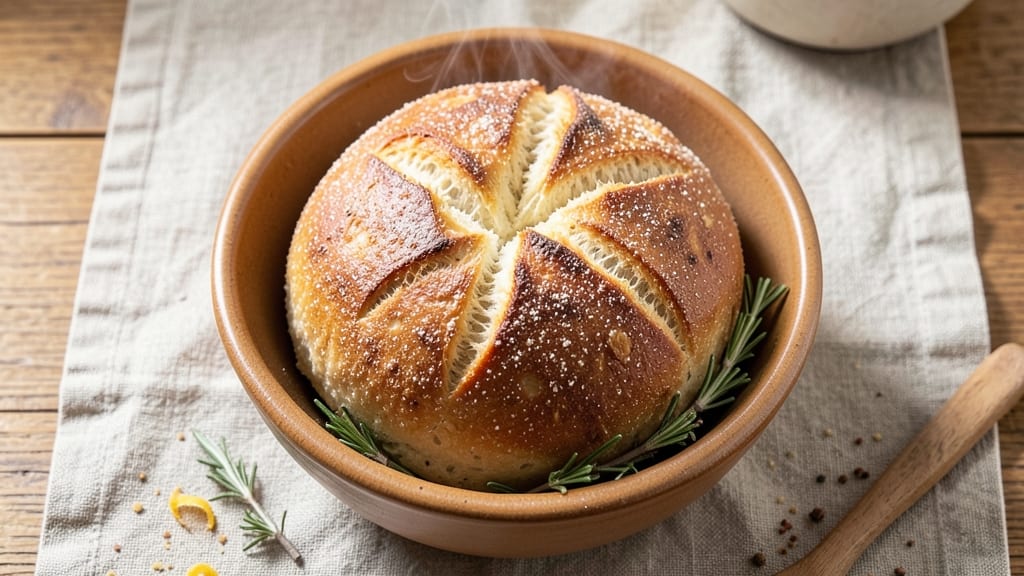
Mastering a round loaf bread recipe with an artisan crust and soft interior is the kind of skill that transforms simple ingredients into something extraordinary.
Standing on a stool in my Nonna’s kitchen, I learned that patience and technique—like letting dough rest overnight—create that perfect balance between crispy crust and airy crumb. This method delivers restaurant-quality results without requiring special equipment.
The secret lies in a simple yet precise process: mixing flour, yeast, and water to form a smooth dough, then shaping it into a round loaf before proofing.
The dough needs time to develop gluten and flavor, which is why I recommend a slow rise—whether overnight in the fridge or a few hours at room temperature. This patience ensures a tender crumb and a golden, crackly crust that’s hard to resist.
By the time it emerges from the oven, you’ll have a loaf with a beautifully blistered crust and a soft, even crumb that’s perfect for sandwiches or serving with soup.
The aroma alone will have everyone asking for seconds. Ready in about 3 hours with minimal effort, this bread proves that homemade can be both impressive and foolproof.
Whether you’re baking for a family dinner or meal prepping for the week, this recipe adapts easily to your needs. The dough is forgiving, and the technique scales from one loaf to a batch. Let’s get started on creating your own perfect round loaf!
Ingredients for round loaf bread
Simple ingredients, big impact—this loaf delivers restaurant-quality crust and crumb every time.
| Ingredient | Amount | Notes |
|---|---|---|
| All-Purpose Flour 🌾 | 5 cups | Spooned and leveled for accuracy |
| Active Dry Yeast 🍞 | ¼ tsp | Fresh or 1 packet (2.25g) |
| Granulated Sugar 🍚 | 1 tbsp | Feeds the yeast for activation |
| Unsalted Butter 🧈 | ½ cup | Cold, cubed for crust development |
| Large Egg 🥚 | 1 whole | Room temperature for even mixing |
| Milk 🥛 | ½ cup | Warmed to 110°F for yeast activation |
| Salt 🧂 | 1 ½ tsp | Kosher or sea salt preferred |
| Water 💧 | 1 ½ cups | Room temperature, filtered if possible |
| Cornmeal 🌽 | ¼ cup | For dusting baking sheet |
| Coarse Sea Salt 🧂 | 1 tsp | For sprinkling on crust |
| Ice Water ❄️ | ¼ cup | For shaping and final proof |
The flour is non-negotiable here—King Arthur or Gold Medal make all the difference. I grab mine from Whole Foods or the bulk bins at Trader Joe’s for freshness. The yeast? Fresh is best—check the expiration date, and if it’s been sitting in your pantry for months, toss it. For the butter, Plugrá or Land O’Lakes unsalted work perfectly. Keep it cold until mixing to get that perfect crust. The milk should be warm but not hot—just enough to melt the butter without killing the yeast. And don’t skimp on the salt; it’s what makes the crust shine.
No active dry yeast? Instant yeast works 1:1, but don’t skip the warm milk step—it’s what activates the dough. Out of butter? Olive oil at half the amount keeps things tender, though you’ll lose that signature crust. Short on milk? Warm water plus a splash of lemon juice mimics the effect. The cornmeal is just for dusting, but if you’re out, semolina or flour work too. For the coarse salt, Maldon or Diamond Crystal give that perfect crunch—don’t use table salt, or you’ll end up with a salty bite. And if your dough feels sticky? Add a splash of ice water to help shape it without sticking to your hands.
This dough is a patient one—it tastes even better after overnight in the fridge. Wrap it tightly in plastic and let it rise slowly for maximum flavor. Once baked, it keeps well for 3-4 days at room temperature, wrapped in a clean towel. For longer storage, freeze the loaf (wrapped in foil) for up to 3 months. Reheat slices in a toaster or oven for that fresh-baked crunch. And trust me, the aroma alone will have everyone thinking you’re a pro.
Why You’ll Love This Recipe
- No-Knead Night Magic: I swear by this dough—just mix, let it rise, and bake. No stand mixer, no arm workout, just hands-off time while you sip tea or scroll. That butter and egg combo makes it tender without fuss.
- Golden Crust Secret: The sugar and butter team up for a crust so crisp it’ll fool you into thinking you spent hours baking. Honestly, the first slice out of the oven is the best part—warm, buttery, and impossible to stop at one.
- Weeknight Wonder: Toss a loaf in the fridge overnight, and breakfast is solved. Toast it fresh for pancakes, split it for sandwiches, or freeze slices for lazy mornings. It’s my go-to for busy days.
- Budget Baking Wins: Flour, yeast, and a stick of butter stretch farther than you’d think. I’ve made this for potlucks, picnic baskets, and even gifts—always the first to disappear. Practical, reliable, and cheap to boot.
Step-by-step instructions for round loaf bread
Here’s how to craft a golden, crackling crust with a light, airy interior—every time.
Activate the Yeast and Mix the Dough
In a small bowl, combine the 1.5 cups water, 1 tbsp granulated sugar, and 0.25 tsp active dry yeast. Let it sit for 5-10 minutes until frothy—this confirms the yeast is alive and ready to work. If it doesn’t bubble, your bread won’t rise properly.
In a large bowl, whisk together the 5 cups all-purpose flour and 1.5 tsp salt. Make a well in the center and pour in the yeast mixture, 0.5 cup milk, and 1 whole large egg. Mix with a wooden spoon until a shaggy dough forms. The dough will feel sticky at first—that’s normal.
Knead Until Smooth and Elastic
Turn the dough onto a lightly floured surface and knead for 8-10 minutes until smooth and elastic. You’ll know it’s ready when it springs back slowly when poked. If the dough feels too sticky, wet your hands slightly to prevent tearing.
For a quicker method, use a stand mixer with a dough hook attachment. Knead on medium speed for 5-6 minutes until the dough pulls away from the sides of the bowl and forms a tight ball. The dough should feel warm but not hot to the touch.
First Rise and Shape the Loaf
Lightly grease a large bowl with a bit of the 0.5 cup unsalted butter and place the dough inside. Cover with a damp towel and let it rise in a warm spot for 1-1.5 hours, or until doubled in size. A warm oven with the light on works perfectly for this.
Once risen, gently punch down the dough to release air. Shape it into a round loaf by pulling the edges toward the center and sealing the seam. Place it seam-side up on a baking sheet dusted with 0.25 cup cornmeal to prevent sticking. Cover and let it rise for another 30-45 minutes until puffy.
Score and Bake for a Crispy Crust
Preheat your oven to 375°F. Using a sharp knife or razor, score the top of the loaf in a decorative pattern—this helps the bread expand evenly and creates a beautiful crust. Brush the top with a bit of melted 0.5 cup unsalted butter and sprinkle generously with 1 tsp coarse sea salt.
Bake for 30-35 minutes until the crust is deep golden brown and sounds hollow when tapped on the bottom. For extra shine, brush the crust with more melted butter after 15 minutes of baking. The internal temperature should reach 190-200°F.
Cool and Serve for Maximum Flavor
Remove the bread from the oven and let it cool on a wire rack for at least 30 minutes. This step is crucial—cooling slowly prevents a gummy crumb. If you can’t wait, use a 0.25 cup ice water trick: Place the loaf in a bowl of ice water for 5 minutes to speed up cooling while keeping it moist.
Slice into thick rounds and serve warm with butter or your favorite jam. The crust should be crisp and crackly, while the interior remains soft and pillowy. Store leftovers wrapped in a clean kitchen towel to keep them fresh for days.
Pro Tips For Making Round Loaf Bread
- Bloom the Yeast: Skip mixing yeast straight into flour—it’ll wake up slower. Instead, dissolve it in warm (not hot) water with a pinch of sugar first, then wait 5–10 minutes until frothy. If it doesn’t bubble, your yeast is dead, and you’ll end up with dense, flat bread. Trust me, this step saves you from scrapping a whole batch.
- Soften the Butter: Cold butter makes tough bread. Rub the unsalted butter into the flour with your fingers until it’s pea-sized and crumbly—like wet sand. This ensures even distribution and a tender crumb. I used to just cut it in chunks, and the texture suffered.
- Shape Like a Ball: Round loaves need a tight seal to rise properly. After kneading, gather the dough into a smooth ball, tucking any loose edges under as you go. If it looks messy, resist the urge to fix it with more flour—just roll it gently on the counter to smooth it out.
- Preheat the Pan: A cold Dutch oven or loaf pan means your bread won’t set up properly. Heat it for 10 minutes with the oven, then dump in the dough straight from the proofing bowl. The residual steam guarantees a crisp crust and even rise. I learned this after my first loaf came out sad and flat.
Creative variations of this dish
Irish Soda Bread Twist
This variation swaps yeast for baking soda and adds buttermilk for a quick-rise loaf with a dense, hearty texture. Use 3 cups all-purpose flour, 1 tsp baking soda, 1 cup buttermilk, 1 tsp salt, and 1 tbsp sugar.
Mix, shape into a round, and bake at 375°F for 25-30 minutes. The crust stays soft, and the crumb is perfect for toast with Irish butter. I first tried this after Nonna’s friend visited from Dublin—she swore by it for breakfast! 🧈
Rosemary Garlic Loaf
Infuse your dough with 2 tbsp finely chopped fresh rosemary and 3 minced garlic cloves during mixing. Brush the baked loaf with melted garlic butter (mix 0.25 cup softened butter with 1 minced garlic clove) for an aromatic twist.
This pairs beautifully with roasted lamb or grilled vegetables. For extra flavor, add 1 tsp dried thyme to the dough. 🌿
Sweet Brioche Adaptation
Transform this into a brioche-style loaf by adding 0.25 cup granulated sugar and 0.25 cup heavy cream to the dough. Replace 0.25 cup butter with 0.5 cup softened butter (or more for richness). Shape into a round, proof, and bake as directed.
The result? A buttery, slightly sweet loaf perfect for French toast or dessert. I tested this after a failed brioche attempt—this version actually worked! 🍞
Seeded Whole Wheat
Boost nutrition by replacing 1 cup all-purpose flour with whole wheat flour. Add 2 tbsp seeds (sunflower, sesame, or flax) and 1 tbsp honey to the dough. The seeds add crunch, while the honey enhances browning.
Bake at 375°F for 35-40 minutes—the extra fiber means it needs a few minutes longer. Store in an airtight container to keep it fresh. 🌾
Olive Oil & Herb Focus
Swap butter for 0.5 cup extra-virgin olive oil and add 1 tbsp dried oregano and 1 tsp lemon zest to the dough. The oil yields a tender crumb and rich flavor, while the herbs brighten the crust.
Brush the baked loaf with a mix of olive oil and lemon juice after baking. This variation is inspired by Mediterranean styles and pairs well with soups or antipasto platters. 🍋
Gluten-Free Option
For a gluten-free version, use 3 cups gluten-free all-purpose flour blend (like King Arthur’s) and add 1 tsp xanthan gum. Reduce water to 1 cup and increase butter to 0.75 cup for structure.
Let the dough rest 20 minutes before shaping, as gluten-free doughs are stickier. Bake at 375°F for 30-35 minutes, covering loosely with foil if the top browns too quickly. 💪
Nutrition facts
Frequently asked questions about making round bread
Why does my round loaf turn out dense instead of light and airy?
Dense bread usually means the gluten didn’t develop enough. Knead the dough for 8-10 minutes by hand (or 5-6 minutes with a mixer) until it springs back when poked. Also, make sure your yeast is active—it should foam within 5-10 minutes when mixed with warm water and sugar. A slow rise (overnight in the fridge) helps too!
Can I make this recipe without a stand mixer?
This dough is perfect for hand-kneading. Work it on a lightly floured surface for 8-10 minutes until smooth and elastic. Wet your hands slightly if it feels too sticky. The extra effort actually builds more gluten, which improves texture. My Nonna always made bread this way—no mixer needed!
How do I get a crispy crust without burning the inside?
Preheat your oven to 375°F and bake for 30-35 minutes, checking at 25 minutes. For extra shine, brush the crust with melted butter after 15 minutes of baking. If the top browns too fast, tent loosely with foil. The internal temperature should reach 190-200°F—use a thermometer to avoid guesswork!
What’s the best way to store homemade round bread?
Let it cool completely, then wrap in a clean kitchen towel or store in an airtight container at room temperature for 3-4 days. For longer storage, freeze the loaf (wrapped in foil) for up to 3 months. To revive, thaw overnight in the fridge and reheat slices in a toaster or oven for crispiness.
Can I add herbs or seeds to this dough?
Yes! Try 2 tbsp fresh rosemary or 2 tbsp seeds (sunflower, sesame) during mixing. For flavor balance, reduce water slightly if adding seeds. The dough may feel stickier—wet your hands when shaping. Herbs work best with a 15-minute proofing boost, while seeds add texture without needing extra time.

- Alton Brown’s Shortbread Cookies Recipe: Buttery Crunch With Vanilla Infusion - October 8, 2026
- Chili’s Blackberry Iced Tea Recipe: Bold Southern Sweetness in Minutes - October 8, 2026
- Ginger Soy BBQ Marinade Recipe: Bold Umami Kick for Grilled Meats - October 8, 2026