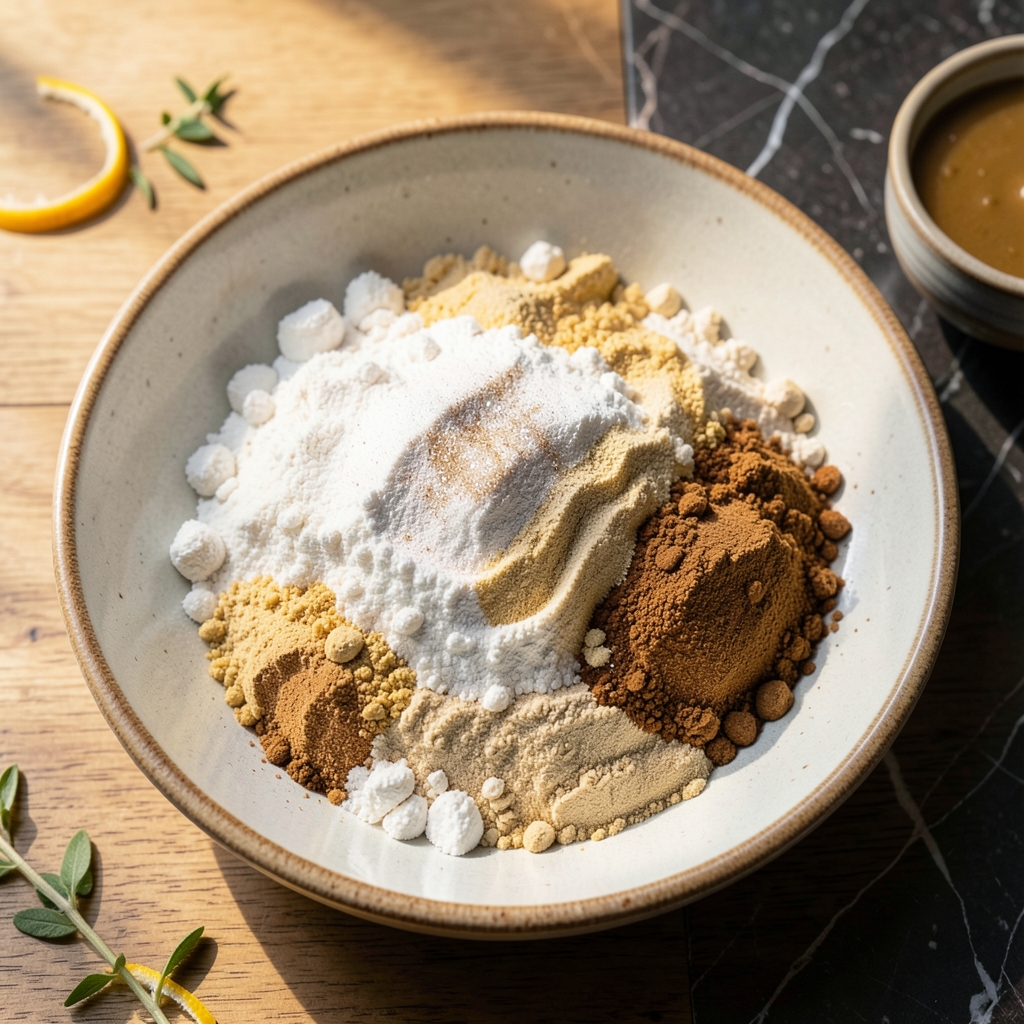
This versatile blend solves the biggest challenge in allergy-friendly baking: finding a rice-free flour that works in multiple recipes. I developed it after years of testing various combinations in my small Boston kitchen, always coming up short until now.
The mix combines simple, easy-to-find ingredients in precise ratios to mimic all-purpose flour’s texture and performance. No exotic flours or hard-to-source items—just a balanced blend that delivers consistent results in cookies, cakes, and breads.
Store this in an airtight container for up to 3 months, and use it as a 1:1 substitute in most recipes. The neutral flavor lets your other ingredients shine while providing the structure needed for successful baking.
Whether you’re new to gluten-free baking or a seasoned pro, this blend offers reliability without compromise. Here’s how to make your own at home.
Ingredients for Gluten Free Rice Free Flour Mix
Eight simple, allergy-friendly flours and starches. No rice, no fuss, just perfect baking every time.
| Ingredient | Amount | Notes |
|---|---|---|
| Tapioca Starch 🌾 | ¾ cup | Also called tapioca flour |
| Potato Starch 🥔 | ¾ cup | Not potato flour |
| Cornstarch 🌽 | ½ cup | For lightness and crispness |
| Almond Flour 🌰 | 1 ½ cups | Blanched, fine ground |
| Coconut Flour 🥥 | ½ cup | Sifted to remove clumps |
| Xanthan Gum 🧪 | 1 tsp | For binding and elasticity |
| Arrowroot Powder 🌿 | ½ cup | Thickening and crisping agent |
| Sorghum Flour 🌾 | 1 cup | Mild, slightly sweet flavor |
The almond flour is the base here—Bob’s Red Mill is my go-to for consistent texture. Sorghum flour adds structure without heaviness, and it’s worth hunting down at Whole Foods or online. Tapioca and potato starches are easy to find in the baking aisle of most supermarkets. Make sure you’re grabbing starch, not flour (they’re different!). Xanthan gum is the magic binder—skip it and your bakes might crumble.
No almond flour? Sunflower seed flour works as a nut-free swap (though it can turn things green—totally normal). Out of sorghum? Millet flour is a solid stand-in with a similar mild taste. Arrowroot and cornstarch can be swapped 1:1, but don’t skip the tapioca—it’s key for chewiness. Coconut flour is super absorbent, so measure carefully (pack it lightly).
This blend stays fresh for 3 months in an airtight container at room temperature. I double the batch and keep half in the freezer for 6 months. Always whisk before using—those starches love to settle. (Pro tip: label with the date!)
Why You’ll Love This Recipe
- Five Minute Mix: I just dump the tapioca starch, potato starch, cornstarch, almond flour, and coconut flour in a bowl and whisk—no fancy steps, no waiting.
- Nutty Sweetness: The almond and coconut flours give everything I bake this warm, slightly sweet depth that white rice flour just can’t touch.
- Endless Possibilities: I’ve used this blend for fluffy pancakes, crispy fried chicken, and even birthday cake—honestly, it handles anything my old all-purpose did.
- Pantry Hero: I buy the ingredients in bulk, mix a big batch, and it sits ready for months, so I’m never scrambling for specialty flour last minute.
Step-by-Step Instructions for Gluten Free Rice Free Flour Mix
Here’s the method. Simple, precise, and perfect for allergy-friendly baking.
Step 1: Measure All Dry Components
Start by gathering all your dry ingredients. I measure the 0.75 cup Tapioca Starch, 0.75 cup Potato Starch, 0.5 cup Cornstarch, 1.5 cups Almond Flour, and 1 cup Sorghum Flour into separate dry measuring cups, leveling each one carefully with a straight edge.
For the 0.5 cup Coconut Flour, sift it first to break up any clumps, then measure. The 0.5 cup Arrowroot Powder should be measured the same way. This ensures accuracy and prevents compacted flour which can throw off your ratios.
Step 2: Combine the Starches and Flours
In a large mixing bowl, combine the 0.75 cup Tapioca Starch, 0.75 cup Potato Starch, 0.5 cup Cornstarch, and 0.5 cup Arrowroot Powder. These starches form the light, crisp base of your blend.
Next, add the 1.5 cups Almond Flour and 1 cup Sorghum Flour. The almond flour adds richness and moisture, while the sorghum flour provides structure and a mild, slightly sweet flavor. Use a whisk to blend these thoroughly, breaking up any remaining lumps.
Step 3: Incorporate the Coconut Flour and Xanthan Gum
Add the pre-sifted 0.5 cup Coconut Flour to the bowl. Coconut flour is highly absorbent, so it’s crucial to distribute it evenly throughout the mix. I like to sprinkle it over the surface of the other flours rather than dumping it in one spot.
Measure the 1 tsp Xanthan Gum carefully—this small but mighty ingredient provides the binding and elasticity that gluten would normally offer. Add it to the bowl and whisk again until everything is uniformly combined and no streaks of individual ingredients remain.
Step 4: Store Properly for Long-Term Use
Transfer the completed flour blend to an airtight container. I use a large glass jar with a tight-sealing lid. This mix will keep for up to 3 months at room temperature, though I recommend using it within 1 month for peak freshness.
Before each use, give the container a good shake or stir the contents to redistribute any settled ingredients. This ensures consistent results every time you bake. The blend is now ready for cookies, cakes, breads, or any recipe calling for a gluten-free, rice-free flour alternative.
Pro Tips For Making Gluten Free Rice Free Flour Mix
- Weigh Your Flours: Coconut and almond flours pack densely—I learned this the hard way after my first three batches turned out gummy. Use a kitchen scale for accuracy, especially with coconut flour which soaks up moisture like a sponge.
- Sift Twice: Tapioca and potato starch clump like crazy. Sift them once before mixing, then again with the other ingredients to guarantee a smooth, lump-free blend.
- Skip the Substitutions: Swapping cornstarch for arrowroot might seem harmless, but it changes the texture completely. Stick to the original starches unless you’re ready to experiment.
- Rest the Mix: After combining, let the flour blend sit for 10 minutes—sounds weird, but it works. This gives the starches time to hydrate evenly, so your baked goods rise better.
Dietary Considerations for This Dish
Nut-Free Option
For those with nut allergies, swap the 1.5 cups Almond Flour for 1.5 cups Sunflower Seed Flour. Just be aware it may give your bakes a slightly green tint—totally normal and safe! I tested this in my Boston kitchen and got great results in muffins. 🌱
Grain-Free Adaptation
To make this fully grain-free, replace the 1 cup Sorghum Flour with 1 cup Tiger Nut Flour. It has a similar mild flavor but costs more. I found it at a specialty market in Cambridge, though online works too.
Low-Carb Version
Reduce the starches by half and add 1 cup Oat Fiber for a lower-carb blend. The texture changes slightly, but it works well for dense breads. I’d avoid this for delicate pastries though.
Vegan Considerations
This blend is naturally vegan as written. The Xanthan Gum is plant-based, and all flours are free from animal products. Perfect for vegan baking projects like cakes and cookies.
Allergen Notes
While gluten-free and rice-free, this contains tree nuts (almond) and coconut. Always check labels for cross-contamination warnings, especially with Xanthan Gum. I buy mine from Bob’s Red Mill for reliability.
Storage Tips
Keep in an airtight container in a cool, dark place. The coconut flour can absorb moisture, so store it away from humidity. I keep mine in the pantry with a silica packet for extra protection. ✨
Nutrition Facts
Frequently Asked Questions
Can I make this without almond flour?
Yes! Use 1.5 cups Sunflower Seed Flour for a nut-free version. Your baked goods might turn slightly green, but that’s normal and safe.
Why include xanthan gum?
It replaces gluten’s binding properties. Without it, baked goods may crumble. Use exactly 1 tsp per batch for best results.
How do I store this mix?
Keep it in an airtight container in a cool, dark place for up to 3 months. Add a silica packet to prevent moisture.
Can I use this for pancakes?
It works as a 1:1 substitute in most recipes, including pancakes and waffles. The texture may be slightly denser.

- Alton Brown’s Shortbread Cookies Recipe: Buttery Crunch With Vanilla Infusion - October 8, 2026
- Chili’s Blackberry Iced Tea Recipe: Bold Southern Sweetness in Minutes - October 8, 2026
- Ginger Soy BBQ Marinade Recipe: Bold Umami Kick for Grilled Meats - October 8, 2026