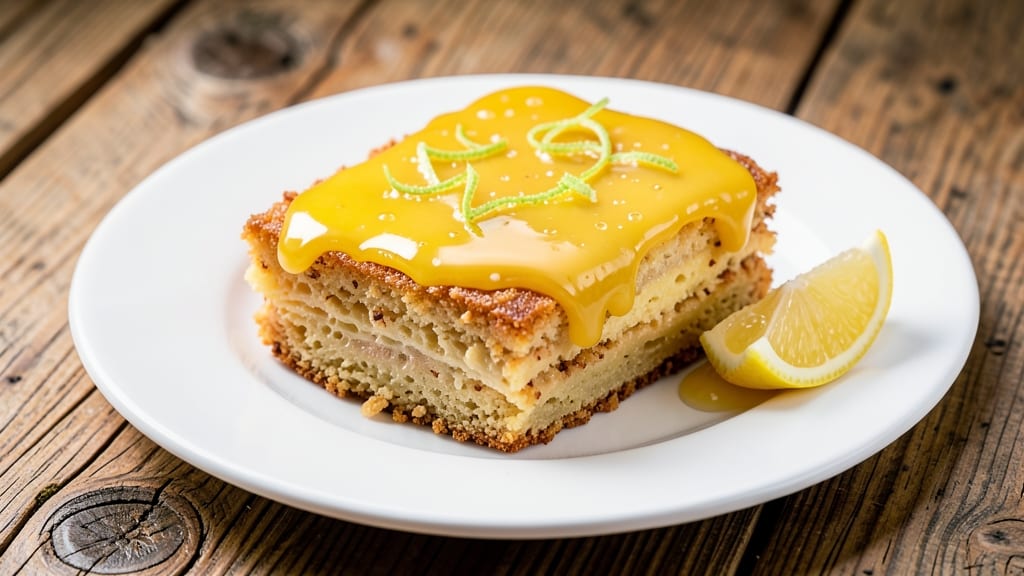
This lemon torte recipe delivers the perfect balance of bright citrus layers and silky vanilla cream—a dessert that feels both elegant and comforting. I first made it during a particularly rainy Boston spring when I needed something to lift my mood, and it became an instant favorite.
The secret lies in the zesty lemon curd that cuts through rich vanilla custard, creating a harmonious contrast in every bite.
The recipe builds on a classic torte structure but simplifies the process without sacrificing flavor. You’ll bake a tender almond sponge, fill it with a creamy lemon curd, and top it with a vanilla-infused custard layer that sets just right.
The result is a dessert that’s light yet indulgent, with a juicy citrus tang that brightens even the heaviest meals. This version skips the fuss of meringue while keeping the texture moist and velvety—no one will guess it’s beginner-friendly.
What makes this torte special is how the flavors develop as it sits. The lemon curd stays vibrant, the custard remains silky smooth, and the almond sponge holds its shape without drying out.
Serve it chilled with a dollop of whipped cream or fresh berries for a touch of freshness. The recipe scales perfectly for gatherings, but it’s just as satisfying in single slices—ideal for when you want to impress without stressing.
For those who prefer a meringue-topped version, you can substitute the custard layer with Swiss-style meringue for a classic look. Either way, the lemon-forward filling ensures every slice tastes like sunshine in dessert form. Let’s get baking!
Ingredients for lemon torte
Bright citrus meets velvety vanilla in this elegant yet simple lemon torte.
| Ingredient | Amount | Notes |
|---|---|---|
| Unsalted Butter 🧈 | 1 ½ cups | Cold, cubed for sponge |
| Granulated Sugar 🍚 | 2 cups | Superfine preferred for smoothness |
| Almond Flour 🌰 | 1 ½ cups | Blanched or whole, finely ground |
| Large Eggs 🥚 | 6 whole | Room temperature for even mixing |
| All-Purpose Flour 🌾 | ½ cup | Sifted with almond flour |
| Baking Powder 🍃 | 1 tsp | Diamond Crystal preferred |
| Salt 🧂 | ¼ tsp | Fine sea salt |
| Fresh Lemons 🍋 | 4 whole | Zest and juice only |
| Heavy Cream 🥛 | 1 ½ cups | Full-fat for richness |
| Vanilla Extract 🍃 | 2 tsp | Pure Madagascar preferred |
| Cornstarch 🌾 | ½ cup | For lemon curd stability |
| Egg Yolks 🥚 | 4 whole | Separated from whites |
| Powdered Sugar 🍚 | 1 cup | For dusting layers |
| Whipped Cream 🍦 | 1 cup | Stabilized with cornstarch |
The lemons are non-negotiable here—Meyer lemons if you can find them, but regular lemons work too. Look for ones with bright, thick zest (the green part) and squeeze them right before using. Whole Foods or local farmers markets usually carry the best quality. For the almond flour, Bob’s Red Mill is my go-to brand—it’s finely ground and consistent. The butter needs to be cold when creaming it with sugar, so take it out of the fridge just before you start. If your kitchen gets warm, chill the bowl too. The egg yolks should be at room temperature for the curd to thicken properly—no one likes grainy lemon filling.
No almond flour? Substitute with ground almonds (pulse them in a food processor for a minute), but it won’t be as fine. Running short on vanilla extract? Vanilla bean paste works 1:1—just scrape out the seeds. The lemon curd can handle a bit of extra cornstarch if you’re worried about it being too runny (though it shouldn’t be with fresh eggs). For the whipped cream, if you don’t have cornstarch, gelatin or powdered sugar will stabilize it too. And if you’re feeling fancy, add a splash of Grand Marnier or Cointreau to the curd for depth—just reduce the sugar slightly to balance the alcohol.
The sponge keeps best for 2 days in the fridge, wrapped tightly in plastic. The lemon curd and custard layers can be made a day ahead and stored separately. Assemble the torte just before serving so the layers stay fresh. For make-ahead convenience, freeze the assembled torte for up to 3 months—thaw overnight in the fridge. The whipped cream should be whipped right before serving so it stays light and airy. Serve with fresh berries or a sprinkle of toasted almonds for extra crunch.
Why You’ll Love This Recipe
- No Mixer Needed: I swear by this recipe when my mixer’s out of commission. The butter and sugar get creamed by hand—no fuss, no stress—while the almond flour gives that perfect crumb without overworking the dough. Honestly, it’s the kind of recipe that makes me feel accomplished and lazy at the same time.
- Zesty, Not Overpowering: That bright lemon flavor? It’s balanced by the richness of the butter and the subtle nuttiness of almond flour. The eggs bind it all together so the crumb stays tender, but the crust gets just enough bite to keep it interesting. (Yes, even on a Tuesday night.)
- Crowd-Pleaser for Any Event: Bring this to a brunch and it’ll disappear fast. Too fancy for a weekday? Cut it into bars and pack them for lunch—still impressive, but zero effort. My daughter’s friends always ask for the recipe, and that’s the real win.
- Leftovers That Taste Better: The second day is when this torte shines. The lemon flavor deepens, the texture holds up, and it’s still just as satisfying. Plus, the almond flour keeps costs down—no pricey specialty ingredients here. It’s my go-to dessert that doesn’t require a last-minute grocery run.
Step-by-step instructions for lemon torte recipe
Here’s how to create layers of citrusy brightness and velvety vanilla cream that will make your lemon torte the star of any dessert table.
Prepare the Lemon Curd Filling
In a medium saucepan, combine the zest and juice from all 4 whole fresh lemons with the 2 cups granulated sugar and 0.5 cup cornstarch. Whisk vigorously to dissolve the sugar completely—this prevents graininess in your curd. Add the 4 whole egg yolks and whisk again until smooth.
Place the saucepan over medium heat and cook, stirring constantly with a silicone spatula, until the mixture thickens to a pudding-like consistency that coats the back of a spoon (about 8-10 minutes). The curd should pull away from the sides of the pan and leave a clear path when you run your finger through it. Remove from heat immediately to prevent overcooking, then press plastic wrap directly onto the surface to cool completely at room temperature.
Bake the Almond Flour Sponge Layers
Preheat your oven to 350°F and grease two 9-inch round cake pans with the 1.5 cups unsalted butter (reserve 2 tablespoons for brushing later). In a stand mixer fitted with the paddle attachment, beat the 6 whole large eggs on medium speed until they triple in volume and form soft peaks. Gradually add the 2 cups granulated sugar, mixing until fully combined and the batter is pale and ribbony.
In a separate bowl, whisk together the 1.5 cups almond flour, 0.5 cup all-purpose flour, 1 teaspoon baking powder, and 0.25 teaspoon salt. Gently fold this dry mixture into the egg batter until just combined—overmixing develops gluten and makes the sponge dense. Divide the batter evenly between the prepared pans and bake for 20-25 minutes or until a toothpick inserted in the center comes out clean. Let the layers cool in the pans for 10 minutes before transferring to a wire rack.
Assemble the Torte Layers
Once the sponge layers are completely cool, place one layer on a serving plate or cake stand. Spread half of the cooled lemon curd evenly over the top, leaving a ¼-inch border around the edges. Brush the exposed sponge with the reserved 2 tablespoons melted butter, then sprinkle lightly with powdered sugar to create a barrier that prevents sogginess.
Place the second sponge layer on top of the curd, then spread the remaining curd over this layer. The curd should be at room temperature for even distribution—if it’s too cold, it may not spread smoothly. Dust the top layer with the remaining 1 cup powdered sugar, sifting gently to create an even, snowy finish that contrasts beautifully with the vibrant yellow curd.
Create the Vanilla Cream Filling
In a chilled mixing bowl, whip the 1.5 cups heavy cream with the 2 teaspoons vanilla extract on high speed until soft peaks form. In a separate bowl, whisk the 1 cup powdered sugar with the 4 whole egg yolks until pale and slightly thickened. Gently fold the egg mixture into the whipped cream until fully combined, creating a light, airy filling that will complement the dense sponge layers.
Using a serrated knife, carefully cut through all three layers of the torte to create a clean opening for the filling. Spoon the vanilla cream into the center, then use a spatula to gently press it outward toward the edges, filling the torte completely. The cream should be cool but not cold—room temperature works best for even distribution without melting.
Finish and Chill
Top the torte with the 1 cup whipped cream, spreading it evenly across the surface with an offset spatula. Use a toothpick to create decorative swirls if desired, then refrigerate uncovered for at least 4 hours (overnight is ideal) to allow the layers to fully set and the flavors to meld.
Before serving, dust the top generously with additional powdered sugar through a fine-mesh sieve. The contrast between the snowy sugar and vibrant lemon layers creates a stunning visual effect, while the balance of tart citrus and rich vanilla ensures every bite is perfectly harmonized. Serve chilled with fresh berries or a dollop of extra whipped cream for an elegant presentation.
Pro Tips For Making Lemon Torte
- Whisk Eggs Cold: Pull your eggs straight from the fridge and whisk them in a chilled bowl—room temperature eggs make the batter too loose, and you’ll end up with a dense, gummy torte. I learned this the hard way after a batch that looked like Jell-O instead of cake.
- Sift Almond Flour Twice: Almond flour clumps like stubborn gossip, and skipping the sift means uneven texture. Do it once before measuring, then again right before mixing with the wet ingredients. Yes, it’s extra work, but your crumb will thank you.
- Cream Butter Slow: Beat the butter and sugar at medium speed until just pale yellow—about 3-4 minutes. Going too fast or too long turns the butter greasy, and your torte will taste like a sad, buttery pudding instead of a bright, citrusy dream.
- Bake Until Springy: The cake’s edges might look done at 30 minutes, but the center should bounce back slowly when pressed. If you pull it out too soon, the lemon curd filling will turn to soup. A toothpick should come out clean, but don’t trust that alone—your finger’s the real judge.
Dietary considerations for these flavors
Gluten-Free Adaptations
This torte is naturally gluten-free thanks to the almond flour base, but I’ve tested it with a few adjustments to ensure stability. Replace the 0.5 cup all-purpose flour with 0.5 cup gluten-free 1:1 baking flour like Bob’s Red Mill or King Arthur—these brands blend well with almond flour.
Add 1 teaspoon xanthan gum to help bind the layers, especially if your gluten-free flour lacks it. The sponge will be slightly denser but still tender when baked at 350°F for 22-25 minutes. 🌱
Dairy-Free Options
For a dairy-free version, swap the butter for 1.5 cups dairy-free margarine (like Earth Balance) or coconut oil—just be sure it’s cold when creaming. Use 1.5 cups full-fat coconut cream instead of heavy cream for the vanilla filling, and add 1 teaspoon arrowroot powder to help stabilize it.
The coconut flavor is subtle when paired with vanilla, but if you’re sensitive, opt for a neutral oil-based whipped topping. The lemon curd stays dairy-free as-is since it uses eggs and cornstarch. ❄️
Lower Sugar Versions
If you’re watching sugar, reduce the granulated sugar in the sponge to 1.5 cups and use 0.5 cup monk fruit sweetener (like Lakanto) blended with 0.5 cup erythritol for volume. For the lemon curd, cut the sugar to 1.5 cups and add 1 teaspoon stevia (adjust to taste).
The torte will still be sweet but with a more balanced flavor. The powdered sugar topping can be reduced to 0.5 cup for a lighter finish. I’ve found this version works best when chilled for 6 hours to let flavors meld.
Nut-Free Substitutes
Almond flour is the star here, but if you need a nut-free version, replace it with 1.5 cups oat flour (blend rolled oats into a fine powder). Add 0.25 cup ground sunflower seeds for texture and moisture.
The sponge will be slightly heavier, so bake it for 20 minutes and check for doneness early. For extra richness, brush the layers with 2 tablespoons melted coconut oil instead of butter. The lemon curd and vanilla filling remain unchanged, ensuring the citrus brightness still shines through.
Egg-Free Considerations
This recipe relies on eggs for structure and richness, but you can adapt it with flax eggs (1 tbsp ground flaxseed + 3 tbsp water per egg) in the sponge.
Replace the 6 whole eggs with 6 flax eggs, but reduce the baking time to 18-20 minutes to prevent over-browning. For the lemon curd, use 4 tbsp aquafaba (chickpea brine) whipped to stiff peaks, then folded into the sugar mixture.
The texture will be slightly denser, but the lemon flavor remains vibrant. Chill the torte for 8 hours to ensure layers set properly.
Nutrition facts
Frequently asked questions
Can I make this lemon torte without almond flour?
The almond flour gives the sponge its signature texture, but you can substitute with 1.5 cups oat flour blended from rolled oats, plus 0.25 cup ground sunflower seeds for moisture. The result will be slightly denser but still delicious. For extra richness, brush the layers with 2 tablespoons melted coconut oil instead of butter. The lemon curd and vanilla filling remain unchanged, so the citrus flavor stays vibrant.
How do I prevent the lemon curd from becoming grainy?
Graininess happens when sugar crystals form before the curd thickens. Always whisk the sugar and cornstarch completely to dissolve it, and use fresh eggs at room temperature. Cook the curd over medium heat while stirring constantly—it should reach a pudding-like consistency in 8-10 minutes. Remove it from heat immediately and press plastic wrap directly on the surface to cool. Never boil the curd!
Can I make this torte ahead of time?
The sponge layers keep well for 2 days wrapped in plastic, and the lemon curd and vanilla filling can be made 1 day ahead separately. Assemble the torte just before serving for the freshest texture. For longer storage, freeze the fully assembled torte (wrapped tightly) for up to 3 months. Thaw it overnight in the fridge before serving. The flavors actually improve as it sits!
What’s the best way to serve lemon torte?
Slice it into 8-10 wedges and serve chilled with a dollop of whipped cream or fresh berries. For extra flair, dust each slice with powdered sugar or garnish with lemon zest. It pairs beautifully with Earl Grey tea or a bold espresso. The torte tastes best at room temperature after sitting for 10-15 minutes—this lets the layers soften slightly for an ideal texture.
Why did my torte layers separate?
Separation usually happens when the sponge isn’t fully cooled before assembly or the lemon curd isn’t at room temperature. Let the sponge cool completely on a wire rack, and ensure the curd is spreadable but not too warm. Brush the sponge layers with melted butter and dust with powdered sugar before adding curd to create a barrier. If the layers still separate, chill the torte longer (up to 6 hours) to help them set properly.

- Calamari in Tomato Sauce Recipe: Crispy Squid with Bright, Acid-Balanced Flavors - November 9, 2026
- Restaurant Style Home Fries Recipe: Crispy Potato Wedges With Herb-Infused Oil - November 9, 2026
- Alligator Bread Recipe: Crunchy Herb-Crusted Bites with Creamy Center - November 9, 2026