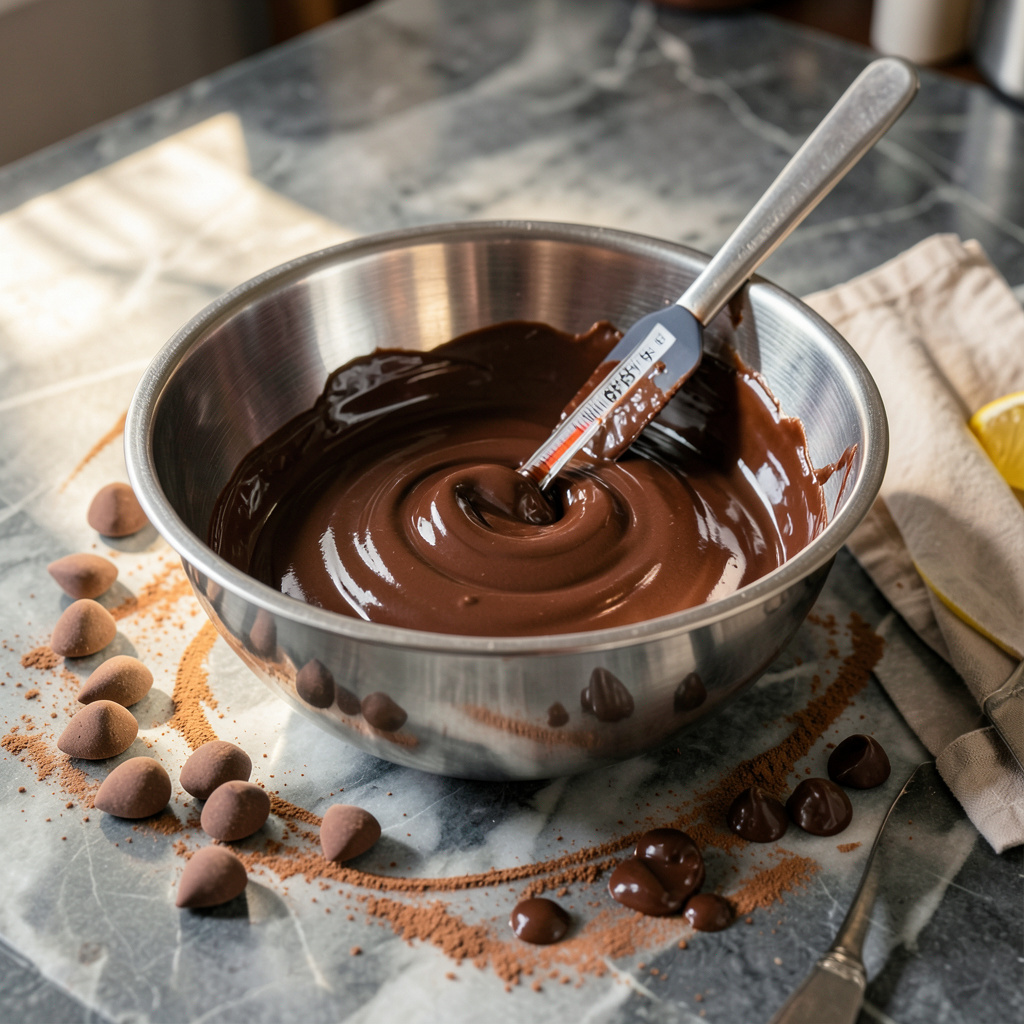
Technically no—chocolate chips contain stabilizers that prevent proper tempering. They melt smoothly but won’t achieve the glossy snap of tempered chocolate. Use high-quality couverture chocolate or bars with 30%+ cocoa butter for true tempering results.
I learned this the hard way after ruining three batches of holiday bark trying to force grocery-store chips into tempered behavior. The issue isn’t your technique—it’s what manufacturers add to keep chips intact during baking. Those little stabilizers (often soy lecithin) act like molecular handcuffs, preventing cocoa butter crystals from forming the tight, uniform structure that gives tempered chocolate its signature shine and crisp break. 💫
Think of it like trying to build a brick wall with Legos—the pieces might stick together, but you’ll never get that solid, professional finish. For projects where appearance and texture matter (like dipped strawberries or molded candies), I now reach for chocolate labeled “couverture” or check the ingredients for 30%+ cocoa butter—it’s the difference between a craft project and pastry-shop results.
💡 In This Article
- Why Chocolate Chips Resist Tempering (And What’s Inside Them)
- How to Fake Tempering with Chocolate Chips (And When to Upgrade)
Why Chocolate Chips Resist Tempering (And What’s Inside Them)
Here’s what’s actually happening inside those tiny chips: manufacturers add stabilizers like soy lecithin (typically 0.3-0.5% of the content) to help them hold their shape during baking. These emulsifiers create a protective barrier around cocoa butter molecules, preventing them from forming the precise crystal structures needed for tempering.
It’s like trying to build a snowflake while wearing mittens—the tools interfere with the delicate process.
The cocoa butter content tells the real story. Most chocolate chips contain only 20-25% cocoa butter, while tempering requires at least 30% for proper crystal formation. That missing 5-10% isn’t just about richness—it’s the difference between a stable crystal matrix and a weak structure that melts unevenly.
🔬 Even premium chips rarely exceed 28% cocoa butter, putting them below the tempering threshold.
Consider the melting behavior: tempering-friendly chocolate liquefies at 88-90°F and sets firmly at 78-80°F. Chocolate chips, however, often contain added waxes or palm kernel oil that alter these temperatures, creating a wider melting range that resists precise control.
This is why your dipped treats might look glossy when warm but develop that dreaded white bloom after cooling—the crystals never had a chance to align properly.
There’s a practical reason for this design. Chocolate chips are engineered for baking stability, not confectionery precision. The same additives that prevent tempering also keep chips from melting into puddles in your cookies at 350°F oven temperatures. It’s a trade-off: baking reliability versus tempering capability.
For reference, professional couverture chocolate contains 32-39% cocoa butter and minimal additives—just cocoa mass, sugar, and vanilla.
The physical shape matters too. Chips’ small surface area means they cool too quickly for proper crystal formation during tempering attempts.
Even if you manage to melt them smoothly, the rapid temperature changes in small pieces make it nearly impossible to achieve the uniform Type V crystals that give tempered chocolate its signature snap and sheen.
Think of it like trying to temper a handful of ice cubes instead of a solid block—the surface-to-volume ratio works against you.
You’ll notice the difference in texture too. Properly tempered chocolate has a clean break and audible snap, while cooled chocolate chips often bend or crumble. This comes down to crystal size—tempered chocolate develops microscopic, uniformly sized crystals, while chip-based chocolate forms larger, irregular clusters that weaken the structure.
✨ The science is clear: for true tempering results, you need chocolate designed for the purpose.

- Alton Brown’s Shortbread Cookies Recipe: Buttery Crunch With Vanilla Infusion - October 8, 2026
- Chili’s Blackberry Iced Tea Recipe: Bold Southern Sweetness in Minutes - October 8, 2026
- Ginger Soy BBQ Marinade Recipe: Bold Umami Kick for Grilled Meats - October 8, 2026