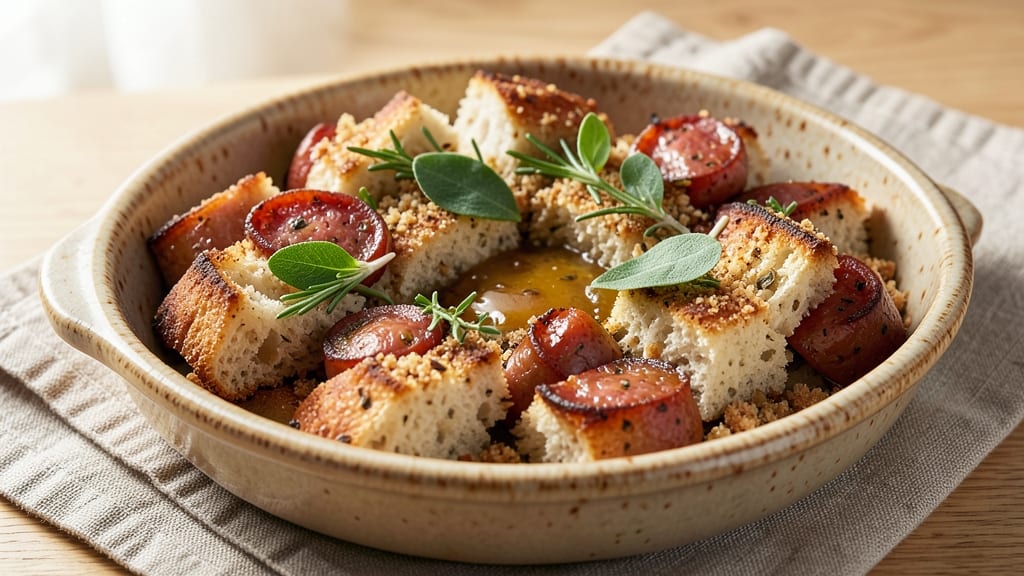
Transforming stale bread into artisan bread stuffing is one of those kitchen alchemy moments that turns leftovers into a showstopping centerpiece. The secret lies in perfectly toasted croutons that develop a satisfying crunch while absorbing rich, herb-infused broth for maximum flavor.
I developed this recipe after years of testing—each batch taught me something new about balancing textures and seasonings.
This stuffing delivers a crispy crust that shatters between your teeth while maintaining a moist, flavorful interior. The process starts with carefully cubing and toasting artisan bread until golden, then building layers of flavor with aromatic herbs, savory sausage, and earthy mushrooms.
A slow bake ensures even moisture distribution without compromising that coveted crispy exterior.
What makes this recipe stand out is its versatility—serve it alongside roasted turkey or ham as a traditional holiday centerpiece, or transform it into a standalone appetizer by shaping it into bite-sized croquettes.
The herb-infused richness pairs beautifully with rich meats while satisfying on its own with a drizzle of pan gravy.
For those who prefer a lighter version, simply reduce the butter and increase the broth ratio. The same technique works for gluten-free bread, making this stuffing adaptable to any dietary need. Let’s create something that will have everyone asking for seconds.
Ingredients for artisan bread stuffing
Sixteen ingredients transform humble bread into a luxurious, herb-infused centerpiece.
| Ingredient | Amount | Notes |
|---|---|---|
| Artisan Bread Loaves 🍞 | 3 whole | Stale or lightly toasted, crust removed |
| Unsalted Butter 🧈 | ¾ cup | Cold, cubed for even distribution |
| Fresh Sage Leaves 🌿 | ½ cup | Finely chopped, stems removed |
| Fresh Thyme Leaves 🌿 | ¼ cup | Finely chopped, stems removed |
| Fresh Rosemary 🌿 | ¼ cup | Finely chopped, woody stems discarded |
| Italian Sausage Links 🌭 | 1 lb | Casings removed, crumbled |
| White Button Mushrooms 🍄 | 1 lb | Finely chopped, stems removed |
| Celery Stalks 🥬 | 3 whole | Finely diced, leafy tops trimmed |
| Yellow Onion 🧅 | 1 whole | Finely diced, medium size |
| Garlic Cloves 🧄 | 4 cloves | Minced, fresh preferred |
| Chicken Broth 💧 | 2 ½ cups | Low-sodium, homemade or quality store-bought |
| Dry White Wine 🍷 | ½ cup | Sauvignon Blanc or Pinot Grigio |
| Diamond Crystal Kosher Salt 🧂 | 1 ½ tsp | Adjust to taste, measure carefully |
| Freshly Ground Black Pepper 🌶️ | 1 tsp | Coarsely ground, freshly cracked |
| Fresh Parsley 🌿 | ¼ cup | Chopped, for garnish and freshness |
The foundation is artisan bread—look for loaves with a dense crumb and minimal additives. Whole Foods or local bakeries offer the best quality, but any crusty bread works in a pinch. For gluten-free adaptations, Schär or Canyon Bakehouse gluten-free bread holds up well when cubed and toasted. The herbs are non-negotiable: fresh sage, thyme, and rosemary from the grocery store’s produce section (not dried) deliver maximum aroma. If using dried, reduce to one-third the amount—Penzeys bulk spices are ideal for consistent quality. The sausage should be high-quality Italian with visible herbs; Trader Joe’s or Costco often carry excellent options.
No fresh herbs? Dried equivalents at one-third the quantity work, though texture will differ. Substitute mushrooms with cremini or shiitake for deeper umami, but white buttons are universally accessible. The wine can be swapped for additional broth plus 1 tsp balsamic vinegar without sacrificing depth. For a vegetarian version, replace sausage with crumbled tempeh or extra mushrooms. The celery and onion should be finely diced—a food processor speeds this up. If your bread is fresh, toast it lightly in the oven at 350°F (175°C) for 10 minutes to remove excess moisture before cubing.
This stuffing reheats beautifully—cover with foil during the second half of baking to retain moisture. Store leftovers in an airtight container for 4-5 days or freeze for up to 3 months. For make-ahead prep, assemble the stuffing (unbaked) in a baking dish, cover, and refrigerate for up to 24 hours. The flavors meld overnight, creating a more cohesive texture. To revive, bake as directed from cold. Garnish with extra fresh parsley just before serving to brighten the presentation.
Why You’ll Love This Recipe
- No-Crumbs Chaos: I swear by this method—just tear that crusty artisan loaf into chunks, no measuring cups needed. The bread soaks up the butter and herbs like a sponge, so you’re not stuck with dry, sad stuffing.
- Herb-Packed Punch: That trio of fresh sage, thyme, and rosemary? It’s like a little aromatic hug in every bite. The butter melts into the bread, turning it into something rich and fragrant—way better than the canned stuff.
- Weeknight & Holiday Hero: Make a double batch on Sunday for Thanksgiving leftovers, or whip up a single pan for a lazy Friday dinner. It reheats beautifully and tastes just as good cold in sandwiches the next day.
- Budget-Friendly Luxury: Artisan bread might sound fancy, but a single loaf stretches into two stuffings—no waste, just flavor. And using fresh herbs (even a few sprigs) makes it taste like you slaved over it, even if you didn’t.
Step-by-step instructions for artisan bread stuffing
Transforming crusty artisan bread into rich, herb-infused stuffing requires precision in technique and timing.
Prepare the Bread Base
Begin by removing the crusts from the 3 whole artisan bread loaves using a serrated knife. Cut each loaf into 1-inch cubes, yielding approximately 8 cups of bread. For optimal texture, lightly toast the cubes in a single layer on a baking sheet in a 350°F oven for 10-12 minutes until they’re dry to the touch but not browned. This step prevents a gummy final product by removing excess moisture.
While the bread toasts, arrange the cubes on a large rimmed baking sheet. I like to spread them out evenly so they brown uniformly. The goal is to create crispy croutons that hold their shape while absorbing the flavorful broth mixture later. If you’re short on time, you can skip toasting and proceed directly to the next step, though the texture will be slightly softer.
Sauté the Vegetable and Meat Mixture
In a large, deep skillet, heat 0.75 cup unsalted butter over medium heat until melted and foaming. Add the 1 lb crumbled Italian sausage links and cook for 5-6 minutes, stirring frequently, until the sausage is fully browned and cooked through. Remove the sausage with a slotted spoon and set it aside on a paper towel-lined plate.
In the same skillet, add 1 lb finely chopped white button mushrooms and cook for 5 minutes until they release their moisture and begin to brown. Add 3 whole finely diced celery stalks, 1 whole finely diced yellow onion, and 4 cloves minced garlic. Continue cooking for 4-5 minutes until the vegetables soften and the onion becomes translucent. This aromatic base forms the flavor foundation of the stuffing.
Combine and Season the Stuffing Mixture
In a large mixing bowl, combine the toasted bread cubes, cooked sausage, and sautéed vegetable mixture. Add 0.5 cup finely chopped fresh sage leaves, 0.25 cup finely chopped fresh thyme leaves, 0.25 cup finely chopped fresh rosemary, 1.5 tsp diamond crystal kosher salt, and 1 tsp freshly ground black pepper. Using your hands, gently toss everything together until the herbs are evenly distributed throughout the mixture.
In a separate bowl, whisk together 2.5 cups chicken broth and 0.5 cup dry white wine. Pour this liquid mixture over the bread and herb combination, stirring gently until fully incorporated. The stuffing should be moist but not soggy—if it appears too dry, add an additional 2 tablespoons of broth. Let the mixture sit for 5 minutes to allow the bread to absorb the liquid completely.
Bake to Golden Perfection
Transfer the stuffing mixture to a greased 9×13-inch baking dish, spreading it evenly and pressing down gently to compact it. Bake in a 375°F oven for 25-30 minutes until the top is golden brown and crispy. If the top begins to brown too quickly, tent it loosely with aluminum foil to prevent over-browning while ensuring the center remains moist.
Once baked, remove the stuffing from the oven and let it rest for 10 minutes before serving. This resting period allows the flavors to meld and the stuffing to set slightly. Garnish with 0.25 cup chopped fresh parsley just before serving to add a pop of color and freshness. The final result should be a rich, aromatic stuffing with crispy edges and tender, flavorful bread cubes infused with herbs and sausage.
Pro Tips For Making Artisan Bread Stuffing
- TOAST THE BREAD LOW: Spread cubed artisan bread on a sheet pan in a single layer and bake at 300°F (150°C) for 10–15 minutes—just until dry and crisp. I used to blast it at 375°F and ended up with burnt edges and a sad, gummy center. Low and slow keeps the texture light while soaking up all that butter later.
- CHOP HERBS FINE: Use kitchen shears or a sharp knife to snip fresh sage, thyme, and rosemary into tiny pieces—no bigger than ¼ inch. Whole sprigs burn before the stuffing cooks through, and you’ll taste them instead of savoring their aroma. (Yes, even the rosemary needles—don’t skip them.)
- BUTTER IN STAGES: Mix in half the butter when assembling the stuffing, then fold in the rest after baking for 20 minutes. The initial butter keeps it moist, while the second layer adds richness without making it greasy. I learned this after a Thanksgiving disaster where the stuffing turned into a sad, oily brick.
- PRESS IT DOWN HARD: Before baking, press the stuffing mixture firmly into the dish—pack it like you’re stuffing a turkey, not just shoving it in. This prevents gaps where it stays undercooked and ensures even browning. (Use your hands or a measuring cup if you’re squeamish about touching raw bread.)
Troubleshooting your artisan bread stuffing
Crusty vs. Soggy Bread
If your stuffing turns out soggy instead of crispy, the bread cubes likely absorbed too much liquid. To fix this, toast your bread cubes longer—aim for 15-20 minutes at 350°F until they’re completely dry to the touch.
For future batches, reduce the broth by ¼ cup and let the mixture rest for 10 minutes before baking to ensure even absorption. 💡
Uneven Browning
Uneven browning usually means the stuffing wasn’t spread evenly or the oven temperature fluctuated. Press the mixture firmly into the baking dish to create an even surface, and use an oven thermometer to confirm your oven hits 375°F.
If the top browns too quickly, tent loosely with foil for the last 10 minutes of baking. Rotate the dish halfway through for consistent color.
Herb Flavor Fading
Fresh herbs lose potency when overcooked. To preserve their flavor, add them after baking—sprinkle chopped parsley or thyme on top just before serving. If using dried herbs, reduce to ⅓ the amount of fresh and fold them into the broth mixture early in the process.
For maximum aroma, I recommend Penzeys bulk herbs for consistent quality. 🌿
Dry or Crumbly Texture
A dry stuffing often results from over-toasting the bread or insufficient liquid. To salvage it,
drizzle warm broth over the baked stuffing and let it sit for 5 minutes before serving.For prevention, lightly toast the bread (just until dry) and add an extra ¼ cup broth to the mixture. Avoid overmixing after adding liquid to maintain a tender crumb.
Broth Not Absorbed
If the stuffing looks wet after baking, the bread cubes weren’t dry enough before mixing.
Toast the bread longer next time—aim for 12-15 minutes at 350°F until golden and crisp. For immediate fixes, bake the stuffing uncovered for the first 15 minutes to evaporate excess moisture before tenting with foil.A splash of white wine in the broth can also help balance the texture. 🍷
Sausage Overcooked
Overcooked sausage turns dry and loses flavor. Remove it from the skillet as soon as it’s browned (about 5-6 minutes), not fully cooked—it’ll finish in the oven.
For extra moisture,
deglaze the pan with 2 tbsp wine after removing the sausage and pour the liquid over the stuffing during baking. Pre-cooking the sausage separately also helps maintain its juiciness. 🌭Nutrition facts
Frequently asked questions
Can I use any bread for this recipe?
While artisan bread delivers the best texture, you can adapt this recipe using baguettes, sourdough, or even gluten-free bread. The key is choosing bread with a dense crumb—avoid soft breads like brioche, which will turn mushy. For gluten-free options, brands like Schär or Canyon Bakehouse work well when toasted thoroughly.
How do I prevent my stuffing from being dry?
Dry stuffing usually means the bread absorbed too much liquid. To fix this, toast your bread cubes longer (15-20 minutes at 350°F) until completely dry before mixing. For future batches, reduce the broth by ¼ cup and let the mixture rest 10 minutes before baking to ensure even absorption.
Can I make this stuffing ahead of time?
Assemble the stuffing (unbaked) in a baking dish, cover tightly, and refrigerate for up to 24 hours. The flavors meld beautifully overnight. To bake, add 5-10 extra minutes to the cooking time if cold. For freezer prep, assemble, cover, and freeze for up to 3 months—thaw overnight in the fridge before baking.
What’s the best way to reheat leftovers?
Reheat stuffing in a 350°F oven for 15-20 minutes, covered with foil, until warmed through. For a crispy top, uncover for the last 5 minutes. Avoid microwaving—it makes the bread rubbery. To revive texture, sprinkle with 2 tablespoons warm broth and let sit for 5 minutes before serving.
How can I make this vegetarian?
Replace the sausage with crumbled tempeh, extra mushrooms, or lentils for protein. For umami depth, add 1 tbsp soy sauce or 1 tsp smoked paprika to the broth. Use vegetable broth instead of chicken broth, and consider adding sun-dried tomatoes or walnuts for texture. The herb ratios remain the same.

- Amish Strawberry Bread Recipe: Buttery Swirls and Fragrant Vanilla Notes - November 8, 2026
- Fried Fish With Tomato Sauce Recipe: Crispy Bites in Zesty Red Sauce - November 8, 2026
- Oven Baked Leg Quarters Recipe: Juicy, Golden Crust Without Dryness - November 8, 2026