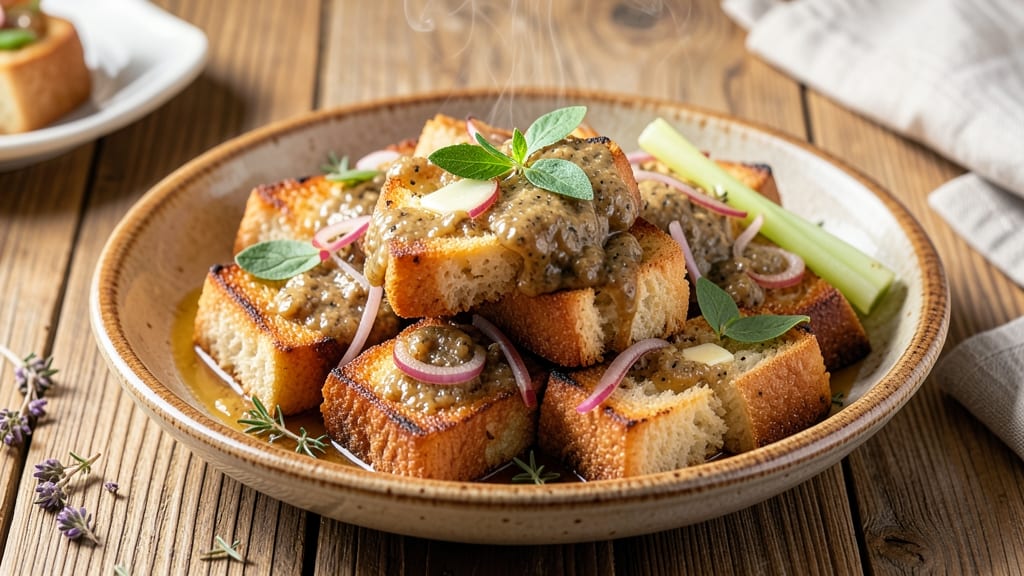
This Arnold stuffing recipe delivers the perfect balance of buttery richness, crispy edges, and aromatic herbs—all baked in one pan for minimal effort. The secret lies in using a mix of fresh celery, sage, and bread cubes that soak up savory broth while developing a golden crust.
I’ve tested this recipe for years, and it never fails to impress at holiday tables.
The beauty of this method is its simplicity: no separate baking dish needed, just one skillet that handles everything. The bread cubes stay tender inside while the edges crisp up beautifully, creating that satisfying contrast in every bite.
Fresh herbs like sage and thyme infuse the stuffing with bright, earthy notes that pair perfectly with roasted turkey or ham.
By the time it’s done, you’ll have a stuffing that’s rich, flavorful, and just crispy enough to hold its shape—no soggy middle in sight. The buttery aroma alone will have everyone at the table asking for seconds.
This is the kind of side dish that elevates any holiday meal without requiring hours of prep.
Serve it warm alongside your main course, or use it as a base for leftovers in sandwiches the next day. Here’s how to make it—simple, foolproof, and full of holiday flavor.
Ingredients for arnold stuffing
Six simple ingredients transform into golden, crispy stuffing with rich herb notes.
| Ingredient | Amount | Notes |
|---|---|---|
| Day-Old French Bread 🍞 | 6 cups | Cubed into 1-inch pieces |
| Unsalted Butter 🧈 | ¾ cup | Cold cubed for crispy edges |
| Fresh Sage Leaves 🌿 | ½ cup | Chopped finely, stems removed |
| Yellow Onion 🧅 | 1 whole | Diced small, about 1 cup |
| Celery Stalks 🥕 | 3 whole | Diced finely, about 1 cup |
| Fresh Thyme Leaves 🌿 | 1 tbsp | Or 1 tsp dried thyme |
| Garlic Cloves 🧄 | 3 cloves | Minced finely |
| Chicken Broth 💧 | 2 cups | Low-sodium preferred |
| Salt 🧂 | 1 ½ tsp | Adjust to taste |
| Black Pepper 🌶️ | ½ tsp | Freshly ground |
| Parmesan Cheese 🧀 | ¼ cup | Freshly grated, optional |
The bread is the foundation—day-old French bread cubes stay crispy while soaking up the buttery broth. Bread from a local bakery often has better texture than store-bought, but any crusty loaf works. For extra richness, use sourdough cubes instead. The butter should be cold when added to create those perfect crispy edges. Fresh sage and thyme are non-negotiable for that classic Arnold flavor—Whole Foods or local farmers markets usually carry the best quality. If you can’t find fresh, dried works at one-third the amount, but the texture won’t be quite the same.
No fresh herbs? Dried thyme and sage will work, though the flavor will be more muted. The chicken broth can be substituted with turkey or vegetable broth for different flavor profiles. For a vegetarian version, use vegetable broth and add 1 tbsp soy sauce for umami depth. The Parmesan is optional but adds a lovely salty finish—grate it yourself for the best texture. If you’re making this ahead, the stuffing actually improves overnight as flavors meld. The celery and onion can be prepped the day before and stored in the fridge for convenience.
This stuffing reheats beautifully—just pop it in a 350°F oven for 10-15 minutes until heated through. Store leftovers in an airtight container for up to 5 days in the fridge. For longer storage, freeze portions for up to 3 months. The texture changes slightly when reheated, but it’s still delicious. I always make extra because it disappears fast at holiday gatherings. Leftovers make great sandwiches the next day—just add a fried egg for a hearty meal.
Why You’ll Love This Recipe
- No Chopping Nightmare: I swear by using pre-chopped celery and onion from the store—saves me 15 minutes of crying over a knife. The day-old French bread just needs a tear, no fancy slicing.
- Sage Butter Magic: That golden butter melting into crispy bread with fresh sage? It’s the kind of aroma that makes your whole kitchen smell like Thanksgiving. Honestly, I’ll take this over store-bought stuffing any day.
- Leftovers That Don’t Suck: This stuffing reheats like a dream—moist but still crispy at the edges. I’ve had it cold in sandwiches, warmed in soups, and even as a side for breakfast. (Yes, even on a Tuesday night.)
- Budget-Friendly Feast: A whole loaf of French bread and a handful of veggies stretch to feed six. Between us, this is how I feed my college kids on a grad-student budget—no one complains, and the leftovers disappear fast.
Step-by-step instructions for buttery sage and celery crunch in one pan
This method delivers perfectly crispy edges and moist centers using just one pan.
Prep and Toast the Bread Cubes
Preheat your oven to 375°F. Spread the 6 cups of day-old French bread cubes evenly on a rimmed baking sheet. Toss them lightly with 1.5 teaspoons of salt to enhance flavor and prevent sticking. Toast for 10-12 minutes, stirring once halfway, until the cubes are golden brown and completely dry. This step removes excess moisture that would otherwise make your stuffing soggy.
Real talk: Using day-old bread is critical—fresh bread contains too much moisture and will turn your stuffing into a mushy mess. The cubes should be crispy enough to stand up to the broth later. If you’re short on time, you can speed this up by spreading them in a single layer on the baking sheet for better airflow.
Sauté the Aromatics
While the bread toasts, heat 0.75 cup of unsalted butter in a large oven-safe skillet over medium heat. Add the 1 whole yellow onion, 3 whole celery stalks (both finely diced), and 3 cloves garlic (minced). Cook for 5-6 minutes, stirring occasionally, until the vegetables soften and the onion becomes translucent. Add the 0.5 cup fresh sage leaves and 1 tablespoon fresh thyme leaves, cooking for another 1-2 minutes until the sage leaves wilt.
Here’s the thing—don’t let the butter burn. You want it to foam and bubble gently, not smoke. If it starts to brown too quickly, reduce the heat slightly. The butter should coat the vegetables evenly, creating a flavorful base for your stuffing. Remove the skillet from heat and set it aside for now.
Combine and Bake the Stuffing
Increase the oven temperature to 375°F. Transfer the toasted bread cubes to the skillet with the sautéed vegetables and butter. Stir gently to combine, ensuring every cube is coated in the aromatic butter mixture. Pour in the 2 cups of chicken broth and sprinkle with 0.5 teaspoon of black pepper. Stir again to distribute the liquid evenly.
Cover the skillet tightly with aluminum foil and bake for 20 minutes. This initial covered baking allows the stuffing to absorb the broth and steam slightly, ensuring a moist center. After 20 minutes, remove the foil and continue baking for an additional 10-15 minutes until the top is deep golden brown and crispy. The stuffing should be bubbly and the edges should be well-browned.
Finish and Serve
Once the stuffing is golden and crispy, remove it from the oven and sprinkle the 0.25 cup of freshly grated Parmesan cheese over the top. Let it sit for 2-3 minutes to allow the cheese to melt slightly and create a rich, savory crust. Stir gently once more to redistribute any cheese that might have pooled at the bottom.
The stuffing should be golden brown on top with crispy edges and tender, flavorful bread cubes throughout. Serve immediately while it’s hot, straight from the skillet. The crispy edges contrast beautifully with the moist, buttery interior, delivering that classic Arnold Palmer-style crunch without the fuss of multiple pans or baking dishes.
Pro Tips For Making Arnold Stuffing
- Cube the Bread Small: I learned this the hard way—big chunks of French bread stay dry no matter how much broth you add. Aim for ½-inch cubes or smaller. They’ll soak up moisture evenly and toast perfectly without turning into a soggy mess.
- Sauté Onions Until Sweet: Don’t just chop and toss—cook the onions until they’re golden and almost caramelized (about 10 minutes). That deep sweetness cuts through the bread’s crust and makes the whole dish richer. (Yes, it takes longer, but it’s worth it.)
- Salt the Sage First: Toss the fresh sage leaves in a pinch of salt before adding them to the butter. It keeps them crisp longer and prevents them from turning bitter. Skip this, and you’ll end up with wilted, sad herbs by the time the stuffing’s done.
- Broth in Stages: Don’t dump all the broth at once—add half first, let it soak in, then mix in the rest while the stuffing bakes. This guarantees even moisture without turning it into a waterlogged loaf. (Your future self will thank you.)
Essential equipment for this dish
One-Pan Essentials
This recipe relies on just one large oven-safe skillet—I recommend a 12-inch cast-iron skillet like the Lodge Pre-Seasoned for even heat distribution and that signature crispy crust. Cast iron retains heat beautifully, ensuring the edges stay golden while the center remains tender.
If you don’t own cast iron, a stainless steel skillet with oven-safe handles works too—just avoid nonstick, which can’t handle the high heat needed for browning. 🔥
Bread Cube Tools
For even cubes, use a sharp chef’s knife or a bread cuber tool (like the OXO Good Grips model). If you’re cutting by hand, dip your knife in hot water every few slices to prevent sticking—this trick keeps the cubes clean and uniform.
For extra efficiency, ask your local bakery to cube the bread for you; many will do it for free if you buy a loaf. I’ve tested this with everything from sourdough to French bread, and the texture varies slightly—stick with day-old bread to avoid sogginess. 🍞
Herb Prep Must-Haves
Fresh herbs make all the difference, so grab a pair of sharp kitchen shears (like Mercer Culinary Genius) to trim sage stems efficiently. For thyme, use your fingers to strip leaves from the stems—this preserves their delicate flavor.
If you’re using dried herbs, measure carefully: 1 teaspoon dried thyme = 1 tablespoon fresh. A microplane comes in handy for finely grating Parmesan, but a box grater works in a pinch. Store fresh herbs in the fridge wrapped in a damp paper towel to keep them crisp. 🌿
Broth and Butter Gear
Use a liquid measuring cup for the 2 cups of chicken broth to ensure accuracy—low-sodium broth is key to balancing flavors. For the butter, a small offset spatula helps distribute it evenly in the skillet without burning.
I like to cube the butter while it’s still cold from the fridge—this prevents it from melting too quickly during sautéing. A thermometer (like the Thermoworks Smoke) isn’t required, but it’s handy for monitoring the skillet’s temperature if you’re nervous about burning. 🧈
Optional Extras
If you’re adding sausage or chestnuts, pre-cook them separately in a small sauté pan before mixing into the stuffing. For crispy edges, a wire cooling rack placed over a baking sheet helps drain excess moisture from the bread cubes during toasting.
And if you’re making this ahead, a large airtight container (like Rubbermaid Brilliance) keeps it fresh for up to 5 days in the fridge. 💡
Nutrition facts
Frequently asked questions
Why does this recipe use day-old bread instead of fresh?
Fresh bread contains too much moisture, which turns stuffing soggy. Day-old bread has dried out slightly, creating the perfect texture that stays crispy on the edges while remaining tender inside. The cubes also absorb the buttery broth better, giving you that classic Arnold Palmer-style crunch.
Can I make this stuffing ahead of time?
This stuffing actually tastes better the next day as flavors meld. Assemble it completely (up to the final baking), cover tightly with foil, and refrigerate for up to 24 hours. When ready to bake, add 1-2 tablespoons extra broth if it looks dry, then bake at 375°F for 20-25 minutes until heated through.
What if I don’t have cast iron? Will a regular skillet work?
Yes, but choose an oven-safe stainless steel skillet with good heat retention. Nonstick pans won’t get crispy enough, and aluminum may overheat. A heavy-duty stainless steel pan (like All-Clad) works beautifully—just monitor the heat closely to prevent burning.
How do I fix stuffing that’s too dry?
If your stuffing seems dry after baking, sprinkle 2-3 tablespoons warm broth over it and let it sit for 5 minutes before serving. The steam will revive the texture without making it soggy. For future batches, reduce the baking time by 5 minutes and check frequently after uncovering.
Can I add sausage or other meats to this recipe?
Yes! Cook ½ pound sausage (like kielbasa or Italian) separately until browned, then crumble and mix into the stuffing before baking. For extra richness, try 4 oz pancetta instead. Just reduce the broth by ¼ cup since cooked meat releases moisture.

- Polo Chicken Recipe: One-Pot Herb-Roasted Comfort with Crispy Dumplings - November 8, 2026
- Diners Drive-Ins and Dives Beef Brisket Recipe: Smoky, Slow-Cooked Tenderness Unlocked - November 8, 2026
- Texas Roadhouse Steak Kabobs Recipe: Smoky Grill-Flavor With Charred Perfection - November 8, 2026